 Store

 EN
 CN
 VI
 IT
 ES
 TH
 JA
 PT
 MS
 KO
 FR
 DE
 ID
For compact robotic joints, reducing the size of the actuator is only part of the engineering challenge. The motor, reduction mechanism, encoder, communication interface, and structural components all have to work within a very limited space without sacrificing torque, positioning accuracy, or response speed. This is particularly important in collaborative robots and biomimetic joints, where every gram and every millimeter can affect the overall mechanical design.
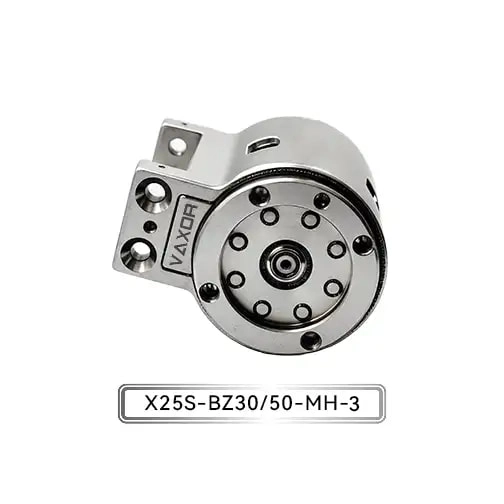
This is where the combination of an axial flux motor and a miniature cycloidal reducer becomes technically interesting. Rather than treating the motor and gearbox as separate components, this architecture integrates the main motion elements into a compact joint module. The Φ25mm Micro Joint Actuator from VAXOR applies this approach to achieve up to 1150 mNm of continuous torque and up to 1800 mNm of initial torque in a compact actuator weighing 93–103 g.
Why Axial Flux Architecture Matters in a Compact Joint
Traditional motor architectures can become difficult to package when a robotic joint requires both high torque and a small overall footprint. An axial flux motor uses a different electromagnetic arrangement, with magnetic flux traveling primarily along the axial direction of the motor.
For a micro joint actuator, this architecture provides an opportunity to use the available internal space more efficiently. The objective is not simply to make the motor smaller. It is to increase the amount of usable torque that can be generated within a restricted mechanical envelope.
The Φ25mm Micro Joint Actuator combines axial flux motor technology with optimized electromagnetic design. This allows the actuator to focus on torque density while maintaining the compact form required for applications such as robotic fingers, compact collaborative robot joints, and biomimetic mechanisms.
For designers, torque density is often more meaningful than motor size alone. A small actuator that cannot generate sufficient torque may require additional mechanical stages or a larger transmission system, increasing both system size and weight.
What the Miniature Cycloidal Reducer Adds
The motor is only one part of the motion system. A robotic joint normally requires substantially higher output torque than the motor can provide directly, making a reduction mechanism essential.
The miniature cycloidal reducer used in this actuator provides two available gear ratios: 30:1 and 50:1. These ratios allow the same basic actuator platform to be configured for different torque and speed requirements.
A lower reduction ratio can be considered when the application needs more output speed, while a higher ratio can provide greater mechanical torque multiplication. The appropriate choice depends on the joint's load, required angular speed, acceleration profile, and available motor operating range.
This is particularly useful in robotic joints because different axes can have very different mechanical requirements. A joint responsible for relatively fast movement may have different priorities from one that needs to hold a higher external load.
By integrating the reduction mechanism into the actuator rather than treating the gearbox as a separate external component, the overall motion module can remain more compact and easier to integrate into the robot's mechanical structure.
30:1 vs 50:1: Choosing the Reduction Ratio
The X25S-UZ/BZ30/50-MH-3 platform offers 30:1 and 50:1 reduction options.
The 30:1 configuration can be suitable when designers need a balance between output torque and rotational speed. It provides substantial torque multiplication while retaining a relatively lower reduction level.
The 50:1 configuration places greater emphasis on output torque and controlled joint movement. It can be more appropriate for mechanisms where higher torque multiplication is more important than maximum output speed.
The decision should not be made from the gear ratio alone. Designers also need to consider the joint's duty cycle, load characteristics, acceleration requirements, motor control strategy, and mechanical inertia.
This is one reason an integrated actuator platform can simplify development. Instead of redesigning the complete joint around different motor and gearbox combinations, engineers can evaluate different configurations within a defined actuator architecture.
1150 mNm Continuous Torque and 1800 mNm Initial Torque
Torque specifications need to be interpreted according to how the actuator will actually operate.
The Φ25mm Micro Joint Actuator provides continuous torque of up to 1150 mNm, while its initial torque can reach up to 1800 mNm. These two figures describe different operating conditions and should not be treated as interchangeable.
Continuous torque is particularly important for applications in which the joint must repeatedly operate or maintain mechanical loads during normal operation. It is therefore a key parameter when evaluating the actuator for robotic joints with sustained or repeated motion.
Initial torque, meanwhile, is relevant when the actuator needs to produce a higher torque level during short-duration motion or starting conditions. This can matter during acceleration, load changes, or other transient operating conditions.
For robot developers, looking at both values gives a more useful picture of the actuator's operating capability than considering a single maximum torque number.
Absolute Magnetic Encoder for Joint Position Feedback
A compact actuator also needs accurate feedback. Without reliable position information, the robot controller cannot effectively determine the joint's actual angular position.
The actuator uses an absolute magnetic encoder. Unlike a basic motor without integrated position feedback, an absolute encoder provides position information that can be used by the control system to determine the joint's angular state.
The non-contact design is also relevant to compact actuator engineering. Magnetic sensing does not require physical contact between the sensing elements, which can help support a compact and integrated feedback architecture.
For robotic applications, encoder integration is especially important because the actuator is part of a closed-loop motion system. The motor produces torque, the reducer converts that torque into joint output, and the encoder provides feedback that allows the controller to regulate the resulting movement.
Why CAN FD Is Relevant to Robotic Joint Integration
Mechanical performance is only part of the integration problem. Modern robotic joints also need a practical communication interface for exchanging control and feedback data with the robot's control architecture.
The Φ25mm Micro Joint Actuator uses CAN FD communication. CAN FD extends the capabilities of traditional CAN communication by supporting larger data payloads and higher data rates under appropriate network conditions.
For a robotic system containing multiple actuators, the communication interface becomes increasingly important. Engineers need to coordinate joint commands, position feedback, status information, and other control data across the system.
CAN FD can therefore be particularly relevant to distributed robotic architectures where several compact actuators communicate within the same control network.
93–103 g Weight and the Impact on Robot Design
At 93–103 g, the actuator is designed for applications where actuator mass needs to be controlled alongside torque output.
Weight becomes especially significant in articulated robotic systems. An actuator mounted farther away from the robot's main body can contribute to the load that upstream joints need to move. Additional actuator mass can therefore influence the mechanical requirements of other joints.
This makes the relationship between actuator weight and output torque an important design consideration.
A compact actuator delivering up to 1150 mNm of continuous torque at a weight range of 93–103 g provides engineers with a defined performance-to-mass point for evaluating their mechanical architecture.
Applications in Collaborative and Biomimetic Robots
The combination of compact dimensions, integrated reduction, encoder feedback, and communication makes the actuator suitable for several types of robotic mechanisms.
Collaborative robots can benefit from compact joint modules because their mechanical structures often need to balance payload capability with a relatively compact form factor. Integrated actuators can also reduce the number of external components that need to be accommodated inside the joint structure.
Biomimetic robots present another demanding application. Human and animal joints combine compact structures with controlled movement across multiple operating conditions. Reproducing similar mechanical behavior requires actuators that can fit into constrained spaces while still providing useful torque and responsive control.
Other potential applications include compact robotic hands, intelligent mechanisms, precision equipment, and specialized robotic joints where integrated motion control is preferred.
From Motor Technology to a Complete Micro-Drive Platform
The architecture behind the actuator reflects a broader approach to micro-drive engineering. VAXOR focuses on combining motor design, precision manufacturing, robotics control, structural design, and intelligent manufacturing rather than developing the motor as an isolated component.
The company's technology roadmap includes axial flux motors, PCB and FPCB winding, optimized electromagnetic design, and miniature reduction mechanisms. These technologies are aimed at developing compact motion solutions with high torque density, fast response, and consistent production performance.
This engineering approach is particularly relevant when an actuator moves from prototype development toward repeatable production. A robotic company may initially evaluate a joint actuator as a standalone component, but successful deployment requires consideration of mechanical integration, control communication, production consistency, and system-level compatibility.
Selecting a Φ25mm Actuator for a Robotic Joint
Before selecting the actuator, engineers should evaluate several parameters together rather than focusing on only the maximum torque specification.
First, determine whether 30:1 or 50:1 reduction better matches the required output speed and torque. Next, check whether the 12–18 V operating range fits the robot's power architecture.
The continuous torque requirement should then be compared with the joint's actual working load and duty cycle, while the initial torque figure should be considered in relation to acceleration and transient loads.
Encoder type and communication interface are also important. An absolute magnetic encoder can support closed-loop joint control, while CAN FD provides a defined communication approach for integration into the robot control network.
Finally, the 93–103 g weight should be evaluated in the context of the complete robot structure. A joint actuator is never an isolated component; its mass, dimensions, torque, feedback, and communication characteristics all influence the surrounding mechanical and electrical design.
Building Compact Robotic Motion Systems
The combination of an axial flux motor and miniature cycloidal reducer is ultimately about system integration. The motor provides the electromagnetic drive, the reducer increases usable output torque, the encoder supplies position feedback, and CAN FD connects the actuator with the broader control system.
For the X25S-UZ/BZ30/50-MH-3 configuration, these elements are brought together in a compact platform offering 12–18 V operation, 30:1 or 50:1 reduction, up to 1150 mNm continuous torque, up to 1800 mNm initial torque, and a 93–103 g weight range.
For engineers developing collaborative robots, biomimetic mechanisms, and other compact robotic systems, the Φ25mm Micro Joint Actuator provides a practical example of how motor architecture, mechanical reduction, sensing, and communication can be integrated into one motion module. As robotic structures continue to become smaller and more distributed, this type of integrated micro-drive architecture can simplify the path from actuator selection to complete joint design.