 Store

 EN
 CN
 VI
 IT
 ES
 TH
 JA
 PT
 MS
 KO
 FR
 DE
 ID
Small robotic joints have to do more than fit into a limited space. They must also provide predictable movement, respond to control commands, and maintain positioning accuracy as the robot performs repeated tasks. In applications such as dexterous robotic hands and highly integrated robotic systems, even a small positioning error can affect how reliably a mechanism grips, adjusts, or interacts with an object.
An encoder helps the control system understand the position of a joint. An absolute magnetic encoder offers a practical approach for compact motion assemblies, where space, feedback accuracy, and integration requirements must be considered together. For engineers evaluating a Φ16mm Micro Joint Actuator, understanding how this feedback technology works can help clarify what to check before integrating a joint module into a robotic design.
Why Position Feedback Matters in Compact Robotic Joints
A robotic joint converts a control command into mechanical movement. However, sending a command does not automatically guarantee that the output shaft reaches the intended position. Mechanical loading, transmission characteristics, acceleration, and control parameters can all affect the final movement.
Position feedback gives the controller information about the joint's actual angular position. The controller can use this information to compare the measured position with the target and adjust its commands when necessary. This feedback is particularly important in dexterous hands, where multiple small joints may need to coordinate finger movements.
Without suitable position information, a robot may struggle to reproduce delicate movements consistently. With an appropriate encoder and control strategy, engineers can develop more predictable motion behavior and improve the coordination of multiple joints.
Encoder selection should therefore be considered alongside the motor, reduction mechanism, controller, and mechanical structure rather than treated as an isolated component decision.
How an Absolute Magnetic Encoder Works
A magnetic encoder determines position by detecting changes in a magnetic field as the sensing components move relative to one another. In a rotary application, the resulting signal is processed to determine angular position.
An absolute encoder provides a position value that corresponds to a particular angular location within its measurement range. This differs from an incremental encoder, which typically tracks movement through changes in its output signals and may require a reference procedure to establish position after startup.
The practical benefit depends on the encoder design and system implementation. Absolute position information can simplify certain initialization procedures and help the controller establish a known position state without relying solely on counting movement from an initial reference.
Engineers should still check the encoder's operating range, resolution, accuracy, interface requirements, and startup behavior. Absolute measurement does not automatically eliminate calibration requirements, mechanical tolerances, or errors elsewhere in the motion system.
What Encoder Accuracy Means for Robotic Applications
The Φ16mm Micro Joint Actuator is specified with angular accuracy of up to 0.02°. This is a useful figure when evaluating applications that require controlled, repeatable joint positioning, including robotic fingers and compact articulated mechanisms.
However, encoder accuracy and overall joint accuracy are not necessarily the same thing. The final position achieved by a complete joint module can also be influenced by reducer characteristics, mechanical compliance, assembly tolerances, control-loop tuning, and external loads.
For example, a robotic finger may need to approach an object gently and stop at a defined angle. The encoder supplies position information, but the controller must interpret that information and adjust motor operation appropriately. The transmission and mechanical structure must also respond consistently for the system to achieve the intended movement.
When comparing joint modules, engineers should clarify how angular accuracy is defined and tested. It is useful to distinguish encoder specifications from the accuracy of the complete actuator under operating conditions. Testing the assembled mechanism under representative loads provides a more meaningful assessment than considering one specification in isolation.
SPI Communication and Controller Integration
An encoder is only useful to the larger system if its position information can be accessed and interpreted correctly. The Φ16mm Micro Joint Actuator uses SPI communication, a synchronous serial interface commonly used to transfer data between electronic devices.
SPI can be suitable for embedded motion-control systems because it provides a direct communication path between a controller and a peripheral device. Before integration, engineers should verify the interface details required by the actuator and its controller, including signal connections, supported clock settings, data format, timing requirements, and any device-specific communication procedures.
The control software must interpret the received position data correctly. Engineers should also consider how frequently the controller needs updated feedback, how communication is scheduled when several joints are operating, and how the system responds if a reading is delayed or invalid.
In a multi-joint robotic hand, these questions become more important as the number of connected modules increases. A communication design that works for a single actuator may require additional planning when the controller must coordinate several joints within a limited cycle time.
A practical integration test should confirm that position readings remain consistent during startup, continuous movement, direction changes, and representative operating loads. Software should also include suitable checks for communication errors and unexpected position values.
Matching the Encoder with the Complete Joint Module
Encoder performance cannot be separated entirely from the actuator architecture. A compact joint module combines electrical, mechanical, and control elements, and each affects the performance of the complete assembly.
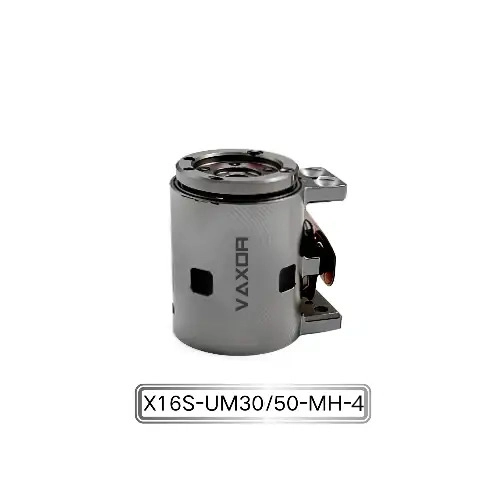
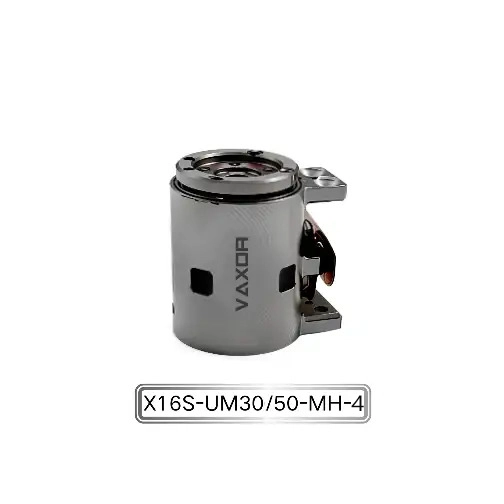
The Φ16mm Micro Joint Actuator, model X16S/L-UM30/50-MH-4, is available in 12 V and 24 V versions with gear ratios of 30:1 and 50:1. Its specified continuous torque reaches up to 200 mNm, while initial torque reaches up to 400 mNm. The listed weight range is 24.3–26.1 g.
These parameters help engineers evaluate whether the module suits a particular joint. The supply voltage must match the electrical system, while the gear ratio should be considered in relation to output speed, torque requirements, and the intended motion profile. Torque figures should be interpreted according to their definitions and test conditions, rather than assumed to represent identical performance under every operating scenario.
Weight and physical dimensions are also important in compact robotic systems. Adding mass to a moving finger or articulated link can influence inertia and the effort required to accelerate or decelerate the mechanism. An integrated module may help simplify packaging, but its mounting interfaces, cable routing, thermal behavior, and service requirements still need to be checked.
For engineers comparing actuator options, the encoder specification is one part of a broader assessment that includes electrical compatibility, mechanical fit, load requirements, and controller support.
Practical Checks Before Integrating a Compact Joint
Before installing an absolute magnetic encoder-based joint module, engineering teams can work through a short validation process.
First, confirm the required angular accuracy for the application. A robotic gripper that performs general positioning may have different requirements from a dexterous hand intended for fine manipulation.
Second, verify electrical and communication compatibility. Check the specified supply voltage and SPI interface requirements, then test position-data acquisition with the actual controller and software.
Third, evaluate performance under realistic mechanical conditions. Test the joint across its intended movement range and under representative loads. Observe whether position feedback remains consistent during acceleration, deceleration, and repeated motion.
Fourth, review the integration details. Confirm mounting dimensions, available installation space, wiring access, and any constraints created by neighboring joints. In a compact hand, the available space for cables and connectors can be as important as the actuator's nominal diameter.
Finally, assess repeatability at the system level. Run repeated motion sequences and compare commanded positions with measured and independently verified output positions where practical. This helps identify whether deviations originate from the encoder, control implementation, transmission, or mechanical assembly.
Designing for Compact, Repeatable Motion
Absolute magnetic encoders can provide useful position feedback in small robotic joint modules, but their value depends on how well the complete motion system is designed and validated. Encoder accuracy, communication reliability, transmission behavior, and controller implementation all contribute to the final result.
Founded in 2024 and headquartered in Suzhou, China, VAXOR develops micro joint actuators and ultra-micro coreless motors for robotics, medical devices, precision instruments, and intelligent equipment. Its engineering capabilities span motor design, precision manufacturing, structural design, and robotics control, supporting development from prototype validation through pilot production and batch delivery.
For applications where space is limited and precise movement matters, the Φ16mm Micro Joint Actuator combines an absolute magnetic encoder, SPI communication, and a compact joint-module format. Engineers can use these specifications as a starting point, then validate electrical compatibility, feedback behavior, and mechanical performance against the requirements of their own robotic systems.
Selecting a suitable joint module ultimately requires more than checking one accuracy figure. A careful evaluation of the encoder, control interface, torque requirements, gear ratio, and full-system behavior provides a more reliable foundation for building compact robotic mechanisms that move consistently.